An asynchronous logger template utilizing background worker threads and object recycling. This class decouples the logging call from the actual I/O operation. It maintains an internal queue of log entries and a pool of worker threads to process them. To minimize heap pressure, it uses a backup pool (object pool) to recycle linked-list nodes. More...
#include <async_logger.h>
Public Types | |
| using | char_type = typename BasicLoggerImpl< char_t >::char_type |
| Alias for the underlying character type. | |
| using | string_type = typename BasicLoggerImpl< char_t >::string_type |
| Alias for the basic_string type associated with this logger's encoding. | |
| using | message_type = typename BasicLoggerImpl< char_t >::message_type |
| Alias for the BasicMessage type associated to the logger. | |
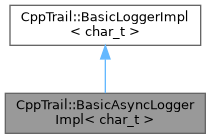
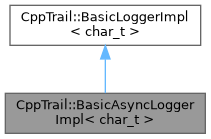
 Public Types inherited from CppTrail::BasicLoggerImpl< char_t > Public Types inherited from CppTrail::BasicLoggerImpl< char_t > | |
| using | char_type = char_t |
| Alias for the underlying character type used by this logger. | |
| using | string_type = std::basic_string< char_type > |
| Alias for the basic_string type associated with this logger's encoding. | |
| using | message_type = BasicMessage< char_type > |
| Alias for the BasicMessage type associated to the logger. | |
| using | string_view_type = std::basic_string_view< char_type > |
| Alias for the basic_string_view type associated with this logger's encoding. | |
Public Member Functions | |
| void | log (message_type oMessage) final |
| Enqueues a log message for asynchronous processing. | |
| void | start () final |
| Starts the background worker pool and the underlying service. | |
| void | stop () final |
| Synchronously shuts down the worker pool and the service. | |
| void | signalStop () final |
| Initiates a shutdown sequence on a separate background "killer" thread. | |
| void | join () final |
| Blocks until all background activity (workers and killer threads) has ceased. | |
| Status | status () final |
| Retrieves the aggregated operational status of the asynchronous logger. | |
| Public Member Functions inherited from CppTrail::BasicLoggerImpl< char_t > | |
| virtual | ~BasicLoggerImpl ()=default |
| Virtual destructor to ensure proper cleanup of derived logger resources. | |
Protected Member Functions | |
| BasicAsyncLoggerImpl () | |
| Default constructor. | |
| BasicAsyncLoggerImpl (std::size_t nMaxEntryCount, bool bThrowOnOverflow, std::size_t nWorkerCount) | |
| Specialized constructor for controlled resource management. | |
| ~BasicAsyncLoggerImpl () override=default | |
| Destructor. | |
| virtual void | work (message_type oMessage)=0 |
| Abstract method for the actual I/O work. | |
Service Lifecycle Interface | |
Hooks for derived classes to manage the underlying sink (e.g., opening sockets). | |
| virtual Status | serviceStatus ()=0 |
| Reports the current operational status of the underlying sink. | |
| virtual void | serviceStart ()=0 |
| Performs the initialization sequence for the sink. | |
| virtual void | serviceStop ()=0 |
| Performs the shutdown sequence for the sink. | |
Detailed Description
class CppTrail::BasicAsyncLoggerImpl< char_t >
An asynchronous logger template utilizing background worker threads and object recycling. This class decouples the logging call from the actual I/O operation. It maintains an internal queue of log entries and a pool of worker threads to process them. To minimize heap pressure, it uses a backup pool (object pool) to recycle linked-list nodes.
- Template Parameters
-
char_t The character type (e.g., char, char8_t) used for log content.
Constructor & Destructor Documentation
◆ BasicAsyncLoggerImpl() [1/2]
|
inlineprotected |
Default constructor.
Initializes a single worker thread and sets an effectively infinite queue limit.
◆ BasicAsyncLoggerImpl() [2/2]
|
protected |
Specialized constructor for controlled resource management.
- Parameters
-
nMaxEntryCount The maximum number of log entries allowed in the queue. bThrowOnOverflow If true, log() throws LoggerOverflowError when full; otherwise, it drops the log. nWorkerCount The number of background threads to spawn for processing.
◆ ~BasicAsyncLoggerImpl()
|
overrideprotecteddefault |
Member Function Documentation
◆ join()
|
finalvirtual |
Blocks until all background activity (workers and killer threads) has ceased.
This is the final synchronization point. It ensures that no background threads are still accessing the logger's memory.
- Note
- This is called automatically by the BasicLogger handle's destructor to ensure RAII safety and prevent "zombie" threads.
Implements CppTrail::BasicLoggerImpl< char_t >.
◆ log()
|
finalvirtual |
Enqueues a log message for asynchronous processing.
This is the primary entry point for logging. It is designed to be high-performance and non-blocking under normal conditions. The message is moved into an internal thread-safe queue to be processed by the worker pool.
- Parameters
-
oMessage The message to be logged. This object is moved; the caller should not rely on its state after this call.
- Exceptions
-
LoggerOverflowError If the internal queue reaches m_nMaxEntryCount and the logger is configured to throw on overflow.
- Note
- If the logger is in Status::STOPPED or Status::BROKEN, the message will be silently discarded to prevent memory leaks during shutdown.
- If overflow occurs and bThrowOnOverflow is false, the message is dropped to prioritize application stability over log completeness.
Implements CppTrail::BasicLoggerImpl< char_t >.
◆ serviceStart()
|
protectedpure virtual |
Performs the initialization sequence for the sink.
This is called internally during the start() sequence. It is the appropriate place to allocate memory, open files, or establish network connections before the worker thread begins processing the log queue.
- Exceptions
-
std::runtime_error or similar if the resource cannot be acquired.
◆ serviceStatus()
|
protectedpure virtual |
Reports the current operational status of the underlying sink.
- Returns
- The current Status of the service.
- Note
- If the sink is considered "always-on" (like std::cout), this should return Status::TRASCENDENT.
◆ serviceStop()
|
protectedpure virtual |
Performs the shutdown sequence for the sink.
This is called internally during the stop() sequence, after the worker thread has finished draining the log queue. It ensures that resources are released gracefully (e.g., sending a TCP FIN or closing a database transaction).
◆ signalStop()
|
finalvirtual |
Initiates a shutdown sequence on a separate background "killer" thread.
This provides a non-blocking alternative to stop(). It spawns a temporary thread that executes the full stop() sequence in the background, allowing the calling thread to continue immediately.
- Note
- Use join() later to ensure this background shutdown has completed.
Implements CppTrail::BasicLoggerImpl< char_t >.
◆ start()
|
finalvirtual |
Starts the background worker pool and the underlying service.
This is a blocking call that ensures the lifecycle is initialized in the correct order:
- It waits for any existing "killer" threads to finish.
- It calls serviceStart() to allow derived classes to acquire resources (files, sockets, etc.).
- It spawns the specified number of background worker threads.
- Note
- This method is thread-safe and prevents multiple simultaneous start sequences.
Implements CppTrail::BasicLoggerImpl< char_t >.
◆ status()
|
finalvirtual |
Retrieves the aggregated operational status of the asynchronous logger.
This method performs a thread-safe evaluation of the logger's health by cross-referencing the underlying service (sink) status with the worker engine's state. The logic follows a "Contract of Expectation":
- If the service is RUNNING/TRASCENDENT, the workers must be ON.
- If the service is STOPPED, the workers must be OFF.
- Any mismatch (e.g., workers running but service stopped) results in Status::BROKEN.
- Returns
- Status The current composite state:
- RUNNING/TRASCENDENT: Fully operational and accepting logs.
- STOPPED: Gracefully shut down; no background activity.
- BROKEN: An inconsistency or critical failure has occurred in the pipeline.
- Note
- This call acquires the worker mutex to ensure a consistent snapshot of the engine state.
Implements CppTrail::BasicLoggerImpl< char_t >.
◆ stop()
|
finalvirtual |
Synchronously shuts down the worker pool and the service.
This method performs a graceful "Drain and Stop" sequence:
- It signals the worker engine to stop accepting new logs.
- It blocks the calling thread until all workers have finished processing the current queue.
- It calls serviceStop() to release resources in the derived implementation.
- Warning
- This is a blocking call. If the queue is large, it may take time to return.
Implements CppTrail::BasicLoggerImpl< char_t >.
◆ work()
|
protectedpure virtual |
Abstract method for the actual I/O work.
Called by worker threads outside of the queue lock.
- Parameters
-
oMessage The message to be recorded.
The documentation for this class was generated from the following file:
- /home/runner/work/cpptrail/cpptrail/include/cpptrail/async_logger.h